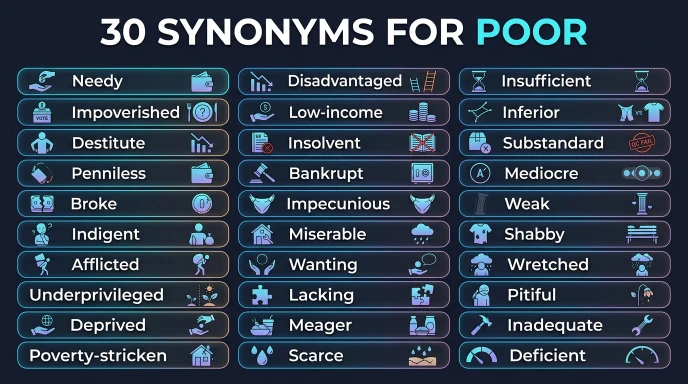
The word poor means having little money, resources, quality, or ability.
Imagine a family that struggles to buy basic needs because they have very little income. People may describe their situation as poor.
The word is commonly used in everyday English because it can describe financial conditions, weak performance, low quality, or a lack of something.
Learning synonyms for poor helps English learners and content writers express ideas more accurately and respectfully.
Different synonyms can describe different meanings, such as having no money, being weak, being unsuccessful, or having low quality.
This article explains the meaning of poor and its synonyms with examples, grammar details, pronunciation, history, word formation, and semantic categories. Understanding these differences helps learners choose suitable words for different situations.
Meaning of Poor
Definition
Poor (Adjective/Noun):
Having little money, limited resources, low quality, or not meeting a good standard.
Examples
- The poor family needed help with food and housing.
- He gave a poor performance in the competition.
Connotative Meaning
(Connotation means the emotional feeling or idea connected with a word beyond its basic dictionary meaning.)
- Positive tone: Can show sympathy, kindness, or a desire to help people in difficult situations.
- Negative tone: Can suggest weakness, failure, low value, or lack of ability.
- Neutral tone: Simply describes a condition of having less money, quality, or success.
Etymology
- The word poor comes from the Old French word povre, meaning “poor, needy, or powerless.”
- It developed from the Latin word pauper, meaning “having little or few resources.”
- The original meaning was connected with poverty and lack of wealth.
Short History
- Old English (450–1100):
English used words such as earm and wædlian to describe poverty and hardship. - Middle English (1100–1500):
The word poor entered English through French influence and became common for describing people with little wealth. - Modern English (1500–Present):
Poor developed broader meanings, including low quality, weak performance, bad condition, and lack of ability.
Pronunciation (US & UK – IPA)
US: /pʊr/
UK: /pʊə/
Syllables
poor
Affixation Pattern of Poor
- Root: pauper (Latin origin)
- Prefix: None
- Suffix: None
Word Formation of Poor
- Poor (adjective): having little money or low quality.
- Poverty (noun): the condition of being poor.
- Poorly (adverb): in a weak or bad way.
- Impoverished (adjective): made poor or lacking resources.
- Impoverish (verb): to make someone poor.
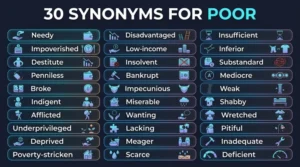
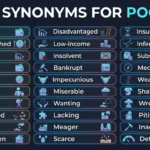
Synonyms of Poor
1. Needy (Adjective)
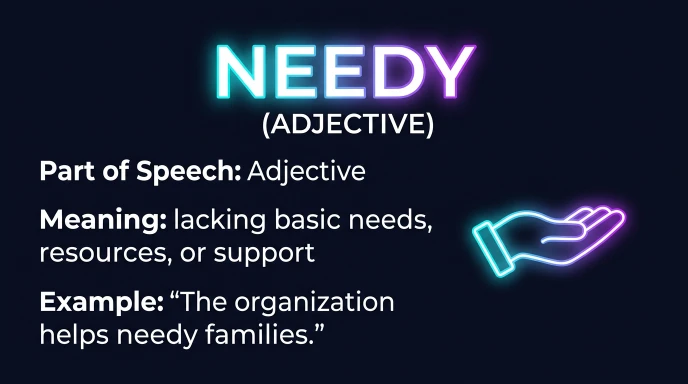
US IPA: /ˈniːdi/ | UK IPA: /ˈniːdi/
Meaning: Lacking basic needs such as money, food, or support.
Examples:
- The organization helps needy families.
- Many needy people received assistance.
2. Impoverished (Adjective)
US IPA: /ɪmˈpɑːvərɪʃt/ | UK IPA: /ɪmˈpɒvərɪʃt/
Meaning: Made extremely poor or lacking resources.
Examples:
- The war left many communities impoverished.
- Impoverished areas need development.
3. Destitute (Adjective)
US IPA: /ˈdestɪtuːt/ | UK IPA: /ˈdestɪtjuːt/
Meaning: Having no money or basic resources.
Examples:
- The charity supports destitute families.
- He became destitute after losing his job.
4. Penniless (Adjective)
US IPA: /ˈpeniləs/ | UK IPA: /ˈpeniləs/
Meaning: Having no money at all.
Examples:
- He arrived in the city penniless.
- The traveler was left penniless after the accident.
5. Broke (Adjective)
US IPA: /broʊk/ | UK IPA: /brəʊk/
Meaning: Having no money.
Examples:
- I cannot buy it because I am broke.
- He was broke after paying his bills.
6. Needy (Adjective)
US IPA: /ˈniːdi/ | UK IPA: /ˈniːdi/
Meaning: Requiring help because of a lack of resources.
Examples:
- The program provides food for needy children.
- They donated clothes to needy families.
7. Deprived (Adjective)
US IPA: /dɪˈpraɪvd/ | UK IPA: /dɪˈpraɪvd/
Meaning: Lacking something important or necessary.
Examples:
- The children lived in a deprived area.
- Some communities are deprived of clean water.
8. Underprivileged (Adjective)
US IPA: /ˌʌndərˈprɪvəlɪdʒd/ | UK IPA: /ˌʌndəˈprɪvəlɪdʒd/
Meaning: Having fewer opportunities or advantages than others.
Examples:
- The school supports underprivileged students.
- They work with underprivileged communities.
9. Disadvantaged (Adjective)
US IPA: /ˌdɪsədˈvæntɪdʒd/ | UK IPA: /ˌdɪsədˈvɑːntɪdʒd/
Meaning: Having fewer benefits or opportunities.
Examples:
- The program helps disadvantaged groups.
- Many disadvantaged children need education support.
10. Penniless (Adjective)
US IPA: /ˈpeniləs/ | UK IPA: /ˈpeniləs/
Meaning: Completely without money.
Examples:
- The artist died penniless.
- She became penniless after the business failed.
11. Lacking (Adjective)
US IPA: /ˈlækɪŋ/ | UK IPA: /ˈlækɪŋ/
Meaning: Not having enough of something needed or expected.
Examples:
- The report was lacking important information.
- The team was lacking experience.
12. Insufficient (Adjective)
US IPA: /ˌɪnsəˈfɪʃənt/ | UK IPA: /ˌɪnsəˈfɪʃənt/
Meaning: Not enough in amount, quality, or level.
Examples:
- The food supply was insufficient.
- He had insufficient time to finish the task.
13. Inferior (Adjective)
US IPA: /ɪnˈfɪriər/ | UK IPA: /ɪnˈfɪəriə/
Meaning: Lower in quality or value.
Examples:
- The product was made with inferior materials.
- This version is inferior to the original.
14. Substandard (Adjective)
US IPA: /ˌsʌbˈstændərd/ | UK IPA: /ˌsʌbˈstændəd/
Meaning: Below the expected level of quality.
Examples:
- The building had substandard conditions.
- The company removed substandard products.
15. Deficient (Adjective)
US IPA: /dɪˈfɪʃənt/ | UK IPA: /dɪˈfɪʃənt/
Meaning: Missing something important or necessary.
Examples:
- The diet was deficient in vitamins.
- The plan was deficient in details.
16. Inadequate (Adjective)
US IPA: /ɪnˈædəkwət/ | UK IPA: /ɪnˈædɪkwət/
Meaning: Not good enough or not enough for a purpose.
Examples:
- The equipment was inadequate for the job.
- His preparation was inadequate.
17. Unsatisfactory (Adjective)
US IPA: /ˌʌnsætɪsˈfæktəri/ | UK IPA: /ˌʌnsætɪsˈfæktəri/
Meaning: Not good enough or not acceptable.
Examples:
- The results were unsatisfactory.
- His performance was unsatisfactory.
18. Weak (Adjective)
US IPA: /wiːk/ | UK IPA: /wiːk/
Meaning: Lacking strength, ability, or quality.
Examples:
- The argument was weak.
- The team had a weak performance.
19. Poor-quality (Adjective)
US IPA: /ˌpʊr ˈkwɑːləti/ | UK IPA: /ˌpʊə ˈkwɒləti/
Meaning: Having low standards or bad quality.
Examples:
- The company received complaints about poor-quality products.
- Poor-quality materials can break easily.
20. Mediocre (Adjective)
US IPA: /ˌmiːdiˈoʊkər/ | UK IPA: /ˌmiːdiˈəʊkə/
Meaning: Only average and not very good.
Examples:
- The movie received mediocre reviews.
- His performance was mediocre.
21. Unsuccessful (Adjective)
US IPA: /ˌʌnsəkˈsesfəl/ | UK IPA: /ˌʌnsəkˈsesfəl/
Meaning: Not achieving the desired result.
Examples:
- The first attempt was unsuccessful.
- The business became unsuccessful.
22. Failed (Adjective)
US IPA: /feɪld/ | UK IPA: /feɪld/
Meaning: Not achieving success.
Examples:
- The project was a failed attempt.
- He learned from his failed experiment.
23. Weakling (Noun)
US IPA: /ˈwiːklɪŋ/ | UK IPA: /ˈwiːklɪŋ/
Meaning: A person or thing considered weak.
Examples:
- Nobody wanted to be seen as a weakling.
- The character was treated as a weakling.
24. Wretched (Adjective)
US IPA: /ˈretʃɪd/ | UK IPA: /ˈretʃɪd/
Meaning: Very poor, unhappy, or unpleasant.
Examples:
- They lived in wretched conditions.
- The old building was in a wretched state.
25. Miserable (Adjective)
US IPA: /ˈmɪzərəbəl/ | UK IPA: /ˈmɪzərəbəl/
Meaning: Very unhappy or in a bad condition.
Examples:
- The workers lived in miserable conditions.
- He felt miserable after the failure.
26. Scarce (Adjective)
US IPA: /skers/ | UK IPA: /skeəs/
Meaning: Difficult to find because there is not enough.
Examples:
- Clean water is scarce in some areas.
- Jobs were scarce during the crisis.
27. Bare (Adjective)
US IPA: /ber/ | UK IPA: /beə/
Meaning: Having very little or only the basic amount.
Examples:
- They survived with bare necessities.
- The room contained only bare furniture.
28. Meager (Adjective)
US IPA: /ˈmiːɡər/ | UK IPA: /ˈmiːɡə/
Meaning: Small in amount or not enough.
Examples:
- He earned a meager income.
- The meal was meager but filling.
29. Paltry (Adjective)
US IPA: /ˈpɔːltri/ | UK IPA: /ˈpɔːltri/
Meaning: Very small or of little value.
Examples:
- They offered a paltry amount of money.
- The reward was paltry compared to the effort.
30. Hard-up (Adjective)
US IPA: /ˌhɑːrd ˈʌp/ | UK IPA: /ˌhɑːd ˈʌp/
Meaning: Having very little money.
Examples:
- Many hard-up families need support.
- He was hard-up after losing his job.
Prototype Meaning
The most typical meaning of poor is having little money or few resources.
When people hear the word poor, they often imagine a person or family who struggles to meet basic needs.
However, the word can also describe low quality, weak performance, or something that does not meet expectations.
Prototype Categorization
- Financial condition synonyms: needy, destitute, penniless, broke, hard-up.
These words describe people who have little or no money. - Lack of resources synonyms: deprived, underprivileged, disadvantaged, lacking, insufficient.
These words describe situations where people or things do not have what they need. - Low-quality synonyms: inferior, substandard, deficient, inadequate, mediocre.
These words describe products, services, skills, or performances that are below standard. - Failure and weakness synonyms: weak, failed, unsuccessful, unsatisfactory.
These words describe poor results or poor ability. - Extreme condition synonyms: wretched, miserable, meager, paltry.
These words show serious difficulty, suffering, or very small amounts.
Categorizing synonyms helps writers choose the right word for each situation. For example, destitute is stronger than needy, while inferior describes quality rather than money. Choosing the correct synonym makes writing clearer, more respectful, and more accurate.
Part 3 will continue with:
- Antonyms of poor
- Short Questions and Answers
- Conclusion
- Meta Description
Antonyms of Poor
- Wealthy (Adjective): Having a large amount of money, property, or valuable resources.
- Rich (Adjective): Having plenty of money or valuable possessions.
- Affluent (Adjective): Having a high level of wealth and financial comfort.
- Prosperous (Adjective): Successful and having good financial conditions.
- Successful (Adjective): Achieving desired goals or positive results.
- Excellent (Adjective): Extremely good in quality or performance.
- Superior (Adjective): Higher in quality, value, or ability.
- Adequate (Adjective): Good enough or sufficient for a purpose.
Short Questions and Answers
- What does poor mean?
Poor means having little money, limited resources, low quality, or a condition that is below an expected standard. It can describe people, things, results, or situations. - When should poor be used?
Use poor when describing a lack of wealth, weak performance, low quality, or an unsatisfactory condition. The meaning depends on the context. - Is poor positive or negative?
Poor usually has a negative tone because it often describes difficulty, weakness, or low quality. However, when describing people in need, it can create a feeling of sympathy and concern. - How is poor different from similar words?
Poor is a general word with many meanings. Destitute describes extreme poverty, inferior describes low quality, and weak describes a lack of strength or ability.
Conclusion
Learning the word poor and its synonyms helps English learners develop a stronger vocabulary and express ideas more accurately.
These words allow speakers and writers to describe financial problems, low quality, weak performance, and difficult conditions with better precision.
Understanding the meanings, pronunciation, tone, and history of each synonym helps learners choose suitable words for different situations.
Using a variety of synonyms reduces repetition and improves writing style. It also helps people communicate with more respect and clarity. Regular vocabulary practice through reading, writing, and conversation builds English confidence and improves both speaking and writing skills. Learning new words every day is a simple step toward better language ability.
Read more about!
- Synonyms for Utilize: 30 Words With Meanings & Examples
- Synonyms for Shown: 30 Words to Boost Vocabulary
- Synonyms for Problems: 30 Words With Meanings & Examples

I am a linguist with 17 years of experience in English language teaching, including postgraduate-level instruction. My expertise includes English grammar, and I contribute as a content and blog writer, producing scholarly and educational language resources.