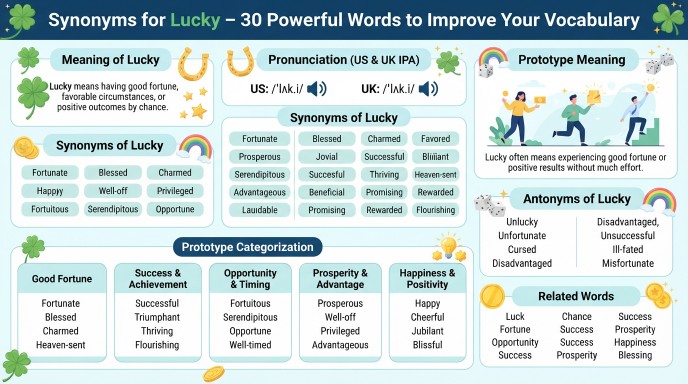
The word lucky means having good fortune or experiencing success because of favorable events. Imagine buying a raffle ticket at a school event and winning a prize. Many people would say you are lucky.
This word is common in daily conversations because people often talk about success, opportunities, and unexpected good outcomes.
Learning synonyms for lucky is important for English learners, students, writers, and content creators. Using different words helps improve vocabulary, makes writing more interesting, and prevents repetition.
It also helps speakers express different shades of meaning more accurately.
In this article, you will learn the meaning of lucky, its pronunciation, grammar, history, connotation, and word formation. You will also discover 30 useful synonyms with examples, semantic categories, antonyms, related words, and practical questions and answers.
Meaning of Lucky
Definition
Lucky (Adjective):
Having good fortune or experiencing positive results by chance.
Examples
- She was lucky to find her lost wallet.
- We felt lucky to get tickets for the concert.
Connotative Meaning
(Connotation: the emotional or cultural feeling connected to a word beyond its basic meaning.)
- Positive tone: Success, fortune, blessing, happiness.
- Negative tone: Sometimes suggests success happened by chance rather than skill.
- Neutral tone: Simply describes favorable circumstances.
Etymology
- Origin: Middle Dutch
- Derived from the word luc meaning happiness or good fortune.
- Entered English during the late Middle English period.
Short History of the Word
Old English (450–1100)
- The word lucky did not exist in Old English.
- People used words related to fortune and fate.
Middle English (1100–1500)
- The concept of luck became more common through European influences.
- Related words began appearing in English.
Modern English (1500–Present)
- Lucky became widely used to describe favorable events and good fortune.
- Today it is one of the most common words for success by chance.
Pronunciation (US & UK – IPA)
US: /ˈlʌki/
UK: /ˈlʌki/
Syllables
luck-y
Affixation Pattern of Lucky
Root: luck
Prefix: None
Suffix: -y
Word Formation of Lucky
- Luck (Noun)
- Lucky (Adjective)
- Luckily (Adverb)
- Unlucky (Adjective)
- Unluckily (Adverb)
- Luckiness (Noun)
- Bad Luck (Noun Phrase)
- Good Luck (Noun Phrase)
Synonyms of Lucky
1. Fortunate (Adjective)
US: /ˈfɔːrtʃənət/ | UK: /ˈfɔːtʃənət/
Meaning: Having good fortune or favorable circumstances.
Examples:
- We were fortunate to arrive safely.
- She felt fortunate to have supportive friends.
2. Blessed (Adjective)
US: /ˈblɛsɪd/ | UK: /ˈblɛsɪd/
Meaning: Having received special favor or happiness.
Examples:
- He feels blessed to have a loving family.
- They were blessed with good health.
3. Favored (Adjective)
US: /ˈfeɪvərd/ | UK: /ˈfeɪvəd/
Meaning: Receiving special advantages.
Examples:
- She was favored by opportunity.
- The team seemed favored by fortune.
4. Prosperous (Adjective)
US: /ˈprɑːspərəs/ | UK: /ˈprɒspərəs/
Meaning: Successful and doing well.
Examples:
- They had a prosperous year.
- The business became prosperous.
5. Successful (Adjective)
US: /səkˈsesfəl/ | UK: /səkˈsesfəl/
Meaning: Achieving desired results.
Examples:
- She became a successful writer.
- The project was successful.
6. Privileged (Adjective)
US: /ˈprɪvəlɪdʒd/ | UK: /ˈprɪvəlɪdʒd/
Meaning: Having special advantages.
Examples:
- He felt privileged to attend.
- We are privileged to learn from experts.
7. Charmed (Adjective)
US: /tʃɑːrmd/ | UK: /tʃɑːmd/
Meaning: Seemingly protected by good fortune.
Examples:
- She lived a charmed life.
- He escaped danger and felt charmed.
8. Auspicious (Adjective)
US: /ɔːˈspɪʃəs/ | UK: /ɔːˈspɪʃəs/
Meaning: Showing signs of future success.
Examples:
- It was an auspicious beginning.
- The event started on an auspicious note.
9. Golden (Adjective)
US: /ˈɡoʊldən/ | UK: /ˈɡəʊldən/
Meaning: Exceptionally favorable.
Examples:
- She had a golden opportunity.
- It was a golden moment.
10. Advantageous (Adjective)
US: /ˌædvənˈteɪdʒəs/ | UK: /ˌædvənˈteɪdʒəs/
Meaning: Providing benefits or advantages.
Examples:
- The timing was advantageous.
- We found an advantageous position.
11. Timely (Adjective)
US: /ˈtaɪmli/ | UK: /ˈtaɪmli/
Meaning: Happening at the right time.
Examples:
- His help was timely.
- The advice arrived at a timely moment.
12. Favoured (Adjective)
US: /ˈfeɪvərd/ | UK: /ˈfeɪvəd/
Meaning: Given special preference.
Examples:
- She was a favoured candidate.
- The plan was favoured by many.
13. Happy (Adjective)
US: /ˈhæpi/ | UK: /ˈhæpi/
Meaning: Feeling pleasure and contentment.
Examples:
- He felt happy about the result.
- We were happy to win.
14. Rewarded (Adjective)
US: /rɪˈwɔːrdɪd/ | UK: /rɪˈwɔːdɪd/
Meaning: Receiving something good after effort.
Examples:
- She felt rewarded for her work.
- Their patience was rewarded.
15. Triumphant (Adjective)
US: /traɪˈʌmfənt/ | UK: /traɪˈʌmfənt/
Meaning: Feeling victory and success.
Examples:
- The team was triumphant.
- He returned home triumphant.
16. Winning (Adjective)
US: /ˈwɪnɪŋ/ | UK: /ˈwɪnɪŋ/
Meaning: Achieving victory or success.
Examples:
- She had a winning attitude.
- The company maintained a winning record.
17. Benefited (Adjective)
US: /ˈbenɪfɪtɪd/ | UK: /ˈbenɪfɪtɪd/
Meaning: Receiving an advantage.
Examples:
- Students benefited from the program.
- We benefited from the change.
18. Thriving (Adjective)
US: /ˈθraɪvɪŋ/ | UK: /ˈθraɪvɪŋ/
Meaning: Growing successfully.
Examples:
- The business is thriving.
- She built a thriving career.
19. Well-Off (Adjective)
US: /ˌwel ˈɔːf/ | UK: /ˌwel ˈɒf/
Meaning: Having enough money and comfort.
Examples:
- They are well-off now.
- His family was well-off.
20. Wealthy (Adjective)
US: /ˈwelθi/ | UK: /ˈwelθi/
Meaning: Having a lot of money.
Examples:
- The wealthy investor helped.
- She became wealthy.
21. Opportune (Adjective)
US: /ˌɑːpərˈtuːn/ | UK: /ˌɒpəˈtjuːn/
Meaning: Happening at a favorable time.
Examples:
- It was an opportune moment.
- They arrived at an opportune time.
22. Promising (Adjective)
US: /ˈprɑːmɪsɪŋ/ | UK: /ˈprɒmɪsɪŋ/
Meaning: Showing signs of future success.
Examples:
- The project looks promising.
- She is a promising student.
23. Serendipitous (Adjective)
US: /ˌserənˈdɪpətəs/ | UK: /ˌserənˈdɪpɪtəs/
Meaning: Happening by a pleasant accident.
Examples:
- Their meeting was serendipitous.
- It was a serendipitous discovery.
24. Flourishing (Adjective)
US: /ˈflɜːrɪʃɪŋ/ | UK: /ˈflʌrɪʃɪŋ/
Meaning: Growing strongly and successfully.
Examples:
- The city is flourishing.
- She runs a flourishing business.
25. Favored-by-Fortune (Adjective)
US: /ˈfeɪvərd/ | UK: /ˈfeɪvəd/
Meaning: Experiencing unusually good luck.
Examples:
- He seemed favored-by-fortune.
- The athlete was favored-by-fortune.
26. Blessedly Successful (Adjective)
US: /ˈblɛsɪdli/ | UK: /ˈblɛsɪdli/
Meaning: Successful in a fortunate way.
Examples:
- The event was blessedly successful.
- Her career was blessedly successful.
27. Gifted (Adjective)
US: /ˈɡɪftɪd/ | UK: /ˈɡɪftɪd/
Meaning: Naturally talented or fortunate.
Examples:
- She is a gifted musician.
- He was gifted with creativity.
28. Favored by Fate (Adjective)
US: /ˈfeɪvərd/ | UK: /ˈfeɪvəd/
Meaning: Appearing to receive good fortune from destiny.
Examples:
- She seemed favored by fate.
- He was favored by fate.
29. Heaven-Sent (Adjective)
US: /ˌhevən ˈsent/ | UK: /ˌhevən ˈsent/
Meaning: Appearing to arrive at the perfect time.
Examples:
- The support was heaven-sent.
- Their help felt heaven-sent.
30. Fortuitous (Adjective)
US: /fɔːrˈtuːɪtəs/ | UK: /fɔːˈtjuːɪtəs/
Meaning: Happening by a lucky chance.
Examples:
- It was a fortuitous meeting.
- They enjoyed a fortuitous opportunity.
Prototype Meaning
The typical meaning of lucky is experiencing something good because of chance.
When people hear the word, they often imagine winning a prize, finding money, receiving unexpected help, or enjoying success through favorable circumstances.
Prototype Categorization
Categorizing synonyms helps writers choose the most suitable word for different situations.
- Good Fortune Words: fortunate, blessed, lucky, fortuitous, serendipitous
- Success Words: successful, triumphant, thriving, flourishing
- Opportunity Words: opportune, advantageous, golden, timely
- Wealth Words: wealthy, well-off, prosperous
- Fate and Destiny Words: charmed, favored by fate, heaven-sent
- Achievement Words: rewarded, winning, benefited
Antonyms of Lucky
- Unlucky (Adjective): Experiencing bad fortune.
- Unfortunate (Adjective): Having poor luck or bad outcomes.
- Cursed (Adjective): Believed to be affected by bad fortune.
- Disadvantaged (Adjective): Lacking favorable conditions.
- Unsuccessful (Adjective): Not achieving desired results.
- Hopeless (Adjective): Having little chance of success.
- Ill-Fated (Adjective): Destined for failure or trouble.
- Misfortunate (Adjective): Affected by bad luck.
Formal and Casual Alternatives
Formal Alternatives
- Fortunate
- Auspicious
- Advantageous
- Opportune
- Fortuitous
- Prosperous
- Privileged
Casual Alternatives
- Lucky
- Charmed
- Golden
- Winning
- Happy
- Blessed
Related Words
- Luck
- Luckily
- Unlucky
- Fortune
- Fortunate
- Fortune-Teller
- Prosperity
- Success
- Blessing
- Opportunity
Short Questions and Answers
- What does lucky mean?
- Lucky means having good fortune or positive results by chance.
- When should lucky be used?
- Use it when describing favorable events, success, or unexpected good outcomes.
- Is lucky positive or negative?
- It is usually positive because it refers to good fortune.
- How is it different from similar words?
- Lucky is general, while fortunate, auspicious, and fortuitous are often more formal and specific.
Conclusion
Learning the word lucky and its synonyms can greatly improve your English vocabulary. Different synonyms help you express ideas more clearly and add variety to your writing and speaking.
Understanding pronunciation, history, connotation, and related words makes learning easier and more meaningful. These vocabulary choices help students, writers, teachers, and English learners communicate with confidence.
They also reduce repetition and make language more engaging. Try using a new synonym each day in conversations, essays, or social media posts. With regular practice, your vocabulary will grow, and your English skills will become stronger, more natural, and more effective.
Explore more about!
- Using Synonyms: 30 Words to Sound Smarter
- Happy Synonyms List with Meaning & Examples
- 30 Synonyms for ‘Solution’ to Boost Your Vocabulary

I am a linguist with 17 years of experience in English language teaching, including postgraduate-level instruction. My expertise includes English grammar, and I contribute as a content and blog writer, producing scholarly and educational language resources.