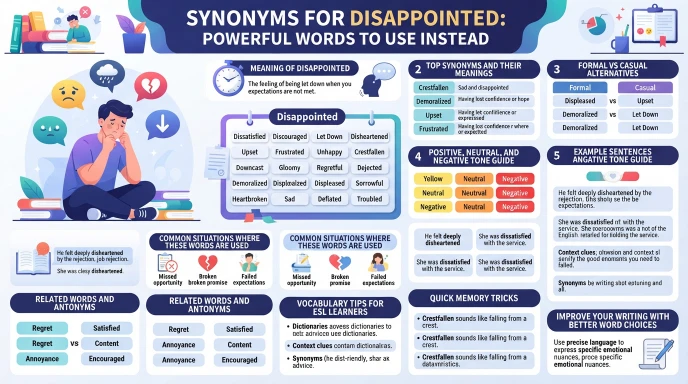
Disappointed means feeling unhappy because something did not happen as expected or hoped. Imagine a student studying hard for a test and expecting a high grade but receiving a lower score. The student may feel disappointed because the result was not what they wanted.
This feeling is common in everyday life, which is why the word disappointed is frequently used in conversations, writing, and storytelling.
Learning synonyms for disappointed helps English learners, students, writers, and content creators express emotions more accurately. Different synonyms can show different levels of sadness, frustration, or dissatisfaction.
In this article, you will learn the meaning of disappointed, its pronunciation, grammar, history, connotation, and word formation. You will also discover 30 useful synonyms with meanings, examples, and semantic categories to improve your vocabulary and communication skills.
Meaning of Disappointed
Definition
Disappointed (Adjective):
Feeling unhappy because something was not as good, successful, or satisfying as expected.
Examples
- She felt disappointed after missing the concert.
- We were disappointed by the team’s performance.
Connotative Meaning
(Connotation: the emotional feeling or idea connected to a word beyond its dictionary meaning.)
- Positive tone: Can encourage learning, growth, or improvement after failure.
- Negative tone: Expresses sadness, frustration, or dissatisfaction.
- Neutral tone: Describes an emotional reaction to unmet expectations.
Etymology
- Origin: From Old French desappointer meaning “to remove from office” or “frustrate.”
- Derived from French appoint meaning “arrange” or “set.”
- Entered English in the 15th century.
- Original meaning: To prevent someone from achieving an expected result.
Short History of the Keyword
- Old English (450–1100): Similar feelings were expressed through words related to sorrow or regret.
- Middle English (1100–1500): French influence introduced words related to failed expectations.
- Modern English (1500–Present): Disappointed became a common term for emotional dissatisfaction when hopes are not fulfilled.
Pronunciation (US & UK – IPA)
US: /ˌdɪsəˈpɔɪntɪd/
UK: /ˌdɪsəˈpɔɪntɪd/
Syllables
dis-ap-point-ed
Affixation Pattern of Disappointed
Root: appoint
Prefix: dis-
Suffix: -ed
Word Formation of Disappointed
- Appoint (Verb) – to assign or select
- Appointment (Noun) – a scheduled meeting
- Disappoint (Verb) – to fail to satisfy expectations
- Disappointed (Adjective) – unhappy due to unmet expectations
- Disappointing (Adjective) – causing disappointment
- Disappointment (Noun) – the feeling of being disappointed
Synonyms of Disappointed
1. Upset (Adjective)
US: /ʌpˈset/ | UK: /ʌpˈset/
Meaning: Feeling unhappy or disturbed.
Examples:
- She was upset about the news.
- He felt upset after the argument.
2. Dissatisfied (Adjective)
US: /dɪsˈsætɪsfaɪd/ | UK: /dɪsˈsætɪsfaɪd/
Meaning: Not pleased with something.
Examples:
- Customers were dissatisfied with the service.
- He felt dissatisfied with the result.
3. Disheartened (Adjective)
US: /dɪsˈhɑrtənd/ | UK: /dɪsˈhɑːtənd/
Meaning: Losing confidence or hope.
Examples:
- She felt disheartened after the loss.
- The team became disheartened.
4. Discouraged (Adjective)
US: /dɪsˈkɜrɪdʒd/ | UK: /dɪsˈkʌrɪdʒd/
Meaning: Feeling less confident about success.
Examples:
- He was discouraged by criticism.
- She felt discouraged after failing.
5. Let Down (Adjective)
US: /let daʊn/ | UK: /let daʊn/
Meaning: Feeling disappointed by someone or something.
Examples:
- I felt let down by the decision.
- They were let down by poor service.
6. Frustrated (Adjective)
US: /ˈfrʌstreɪtɪd/ | UK: /frʌˈstreɪtɪd/
Meaning: Upset because progress is difficult.
Examples:
- She felt frustrated with the delays.
- He became frustrated quickly.
7. Sad (Adjective)
US: /sæd/ | UK: /sæd/
Meaning: Feeling unhappy.
Examples:
- She felt sad after the event.
- The news made him sad.
8. Regretful (Adjective)
US: /rɪˈɡretfəl/ | UK: /rɪˈɡretfəl/
Meaning: Feeling sorrow about something.
Examples:
- He felt regretful about his choice.
- She looked regretful afterward.
9. Unhappy (Adjective)
US: /ʌnˈhæpi/ | UK: /ʌnˈhæpi/
Meaning: Not happy or satisfied.
Examples:
- She seemed unhappy with the outcome.
- He was unhappy about the change.
10. Crestfallen (Adjective)
US: /ˈkrestˌfɔlən/ | UK: /ˈkrestˌfɔːlən/
Meaning: Feeling deeply disappointed.
Examples:
- He looked crestfallen after losing.
- She became crestfallen instantly.
11. Downhearted (Adjective)
US: /ˌdaʊnˈhɑrtɪd/ | UK: /ˌdaʊnˈhɑːtɪd/
Meaning: Feeling low in spirits.
Examples:
- The player felt downhearted.
- She sounded downhearted.
12. Gloomy (Adjective)
US: /ˈɡlumi/ | UK: /ˈɡluːmi/
Meaning: Feeling sad and pessimistic.
Examples:
- He felt gloomy all day.
- The loss left her gloomy.
13. Dejected (Adjective)
US: /dɪˈdʒektɪd/ | UK: /dɪˈdʒektɪd/
Meaning: Feeling unhappy and discouraged.
Examples:
- She appeared dejected.
- He was dejected after the defeat.
14. Deflated (Adjective)
US: /dɪˈfleɪtɪd/ | UK: /dɪˈfleɪtɪd/
Meaning: Feeling less confident or hopeful.
Examples:
- The criticism left him deflated.
- She felt deflated after failing.
15. Demoralized (Adjective)
US: /dɪˈmɔrəˌlaɪzd/ | UK: /dɪˈmɒrəlaɪzd/
Meaning: Losing confidence and enthusiasm.
Examples:
- The team felt demoralized.
- Workers became demoralized.
16. Disillusioned (Adjective)
US: /ˌdɪsɪˈluʒənd/ | UK: /ˌdɪsɪˈluːʒənd/
Meaning: Disappointed after discovering reality.
Examples:
- She became disillusioned.
- He felt disillusioned by politics.
17. Bitter (Adjective)
US: /ˈbɪtər/ | UK: /ˈbɪtə/
Meaning: Angry because of disappointment.
Examples:
- He felt bitter about the outcome.
- She remained bitter for years.
18. Sorrowful (Adjective)
US: /ˈsɔroʊfəl/ | UK: /ˈsɒrəʊfəl/
Meaning: Feeling great sadness.
Examples:
- She looked sorrowful.
- His voice sounded sorrowful.
19. Melancholy (Adjective)
US: /ˈmelənkɑli/ | UK: /ˈmelənkəli/
Meaning: Quietly sad.
Examples:
- He felt melancholy.
- The song made her melancholy.
20. Blue (Adjective)
US: /bluː/ | UK: /bluː/
Meaning: Feeling sad or down.
Examples:
- She felt blue today.
- He seemed blue after the loss.
21. Hurt (Adjective)
US: /hɜrt/ | UK: /hɜːt/
Meaning: Emotionally wounded.
Examples:
- She felt hurt by the comment.
- He was hurt by the rejection.
22. Troubled (Adjective)
US: /ˈtrʌbəld/ | UK: /ˈtrʌbəld/
Meaning: Feeling worried or upset.
Examples:
- She looked troubled.
- He felt troubled by the result.
23. Aggrieved (Adjective)
US: /əˈɡrivd/ | UK: /əˈɡriːvd/
Meaning: Feeling unfairly treated.
Examples:
- He felt aggrieved by the decision.
- She sounded aggrieved.
24. Miserable (Adjective)
US: /ˈmɪzərəbəl/ | UK: /ˈmɪzərəbl/
Meaning: Extremely unhappy.
Examples:
- He felt miserable afterward.
- She was miserable all week.
25. Pained (Adjective)
US: /peɪnd/ | UK: /peɪnd/
Meaning: Showing emotional suffering.
Examples:
- She gave a pained smile.
- He looked pained.
26. Unfulfilled (Adjective)
US: /ˌʌnfʊlˈfɪld/ | UK: /ˌʌnfʊlˈfɪld/
Meaning: Not achieving hopes or goals.
Examples:
- She felt unfulfilled at work.
- He remained unfulfilled.
27. Unsatisfied (Adjective)
US: /ʌnˈsætɪsfaɪd/ | UK: /ʌnˈsætɪsfaɪd/
Meaning: Not content with a result.
Examples:
- The customer was unsatisfied.
- He felt unsatisfied afterward.
28. Heavy-hearted (Adjective)
US: /ˌhevi ˈhɑrtɪd/ | UK: /ˌhevi ˈhɑːtɪd/
Meaning: Feeling deep sadness.
Examples:
- She left heavy-hearted.
- He felt heavy-hearted after the news.
29. Low (Adjective)
US: /loʊ/ | UK: /ləʊ/
Meaning: Feeling emotionally down.
Examples:
- He felt low that day.
- She seemed low after the event.
30. Despondent (Adjective)
US: /dɪˈspɑndənt/ | UK: /dɪˈspɒndənt/
Meaning: Feeling hopeless and disappointed.
Examples:
- He became despondent.
- She looked despondent after the failure.
Formal and Casual Alternatives
Formal Synonyms
- Dissatisfied
- Disillusioned
- Demoralized
- Aggrieved
- Despondent
- Dejected
- Regretful
- Discouraged
Casual Synonyms
- Upset
- Sad
- Blue
- Hurt
- Low
- Let Down
- Gloomy
- Unhappy
Related Words
- Disappointment
- Dissatisfaction
- Frustration
- Regret
- Sadness
- Discouragement
- Failure
- Emotion
- Expectation
- Reaction
Prototype Meaning
The prototype meaning of disappointed is feeling unhappy because reality does not match expectations.
Most people imagine someone who hoped for a good result but received a poorer outcome, causing feelings of sadness, frustration, or dissatisfaction.
Prototype Categorization
- Mild Disappointment: Upset, Unhappy, Low, Blue
- Sadness-Based Feelings: Sad, Sorrowful, Melancholy, Heavy-hearted
- Loss of Hope: Discouraged, Disheartened, Demoralized, Despondent
- Dissatisfaction: Dissatisfied, Unsatisfied, Let Down, Frustrated
- Deep Emotional Pain: Hurt, Pained, Dejected, Crestfallen
- Reality vs. Expectations: Disillusioned, Regretful, Aggrieved, Unfulfilled
Categorization helps writers choose the most accurate synonym. For example, frustrated suggests difficulty, while crestfallen shows visible disappointment and disillusioned emphasizes lost beliefs.
Antonyms of Disappointed
- Satisfied (Adjective) – pleased with a result
- Happy (Adjective) – feeling joy or pleasure
- Delighted (Adjective) – very pleased
- Pleased (Adjective) – feeling content
- Thrilled (Adjective) – extremely excited and happy
- Encouraged (Adjective) – feeling hopeful
- Optimistic (Adjective) – expecting good outcomes
- Fulfilled (Adjective) – feeling satisfied and complete
Short Questions and Answers
- What does disappointed mean?
It means feeling unhappy because something did not happen as expected. - When should disappointed be used?
Use it when describing sadness or dissatisfaction caused by unmet expectations. - Is disappointed positive or negative?
It is generally negative because it describes an unpleasant feeling. - How is it different from similar words?
Disappointed focuses on unmet expectations, while sad is broader and frustrated often involves obstacles or difficulties.
Conclusion
Learning the word disappointed and its synonyms helps you describe emotions more accurately and naturally. Different synonyms express different levels of sadness, frustration, regret, and dissatisfaction.
By understanding these words, you can improve both your writing and speaking skills while avoiding repetitive language.
Learning pronunciation, history, connotation, and semantic categories also helps you choose the right synonym for the right situation. if you are an English learner, student, teacher, or writer, expanding your emotional vocabulary will make your communication stronger and clearer.
Practice using these synonyms in daily conversations and writing to build confidence and develop a richer English vocabulary.
Read more about!
- 30 Powerful Synonyms for Future You Should Know
- 30 Synonyms for “Safe” to Level Up Your Writing
- 30 Powerful Synonyms for Various You Should Know

I am an American author, and I write books about power, strategy, and human behavior. My writing style is simple but deep, and I try to explain how people think and act in real-life situations.
I studied classical studies, and before becoming a writer, I worked in different fields which helped me understand people and life better.
My most famous books include The 48 Laws of Power, The Art of Seduction, and Mastery. These books are widely read by business people, leaders, and students around the world.