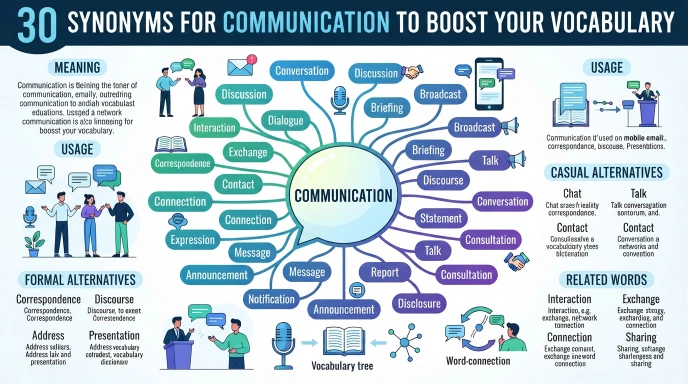
Communication means sharing information, ideas, thoughts, or feelings with other people. Imagine a student explaining a project to classmates or a friend sending a message about weekend plans. In both situations, communication helps people understand each other.
The word communication is common in daily life, school, business, and online conversations. Good communication helps people build relationships, solve problems, and work together effectively.
Learning synonyms for communication is useful for English learners, writers, students, teachers, and content creators. It helps improve vocabulary, makes writing more interesting, and prevents repetition.
In this article, you will learn the meaning of communication, its pronunciation, history, grammar, connotation, and 30 useful synonyms with examples. You will also explore semantic categories, antonyms, and practical questions and answers to strengthen your English skills.
Meaning of Communication
Definition
Communication (Noun):
The process of sharing information, ideas, feelings, or messages between people.
Examples
- Communication is important in every workplace.
- Good communication helps friends understand each other better.
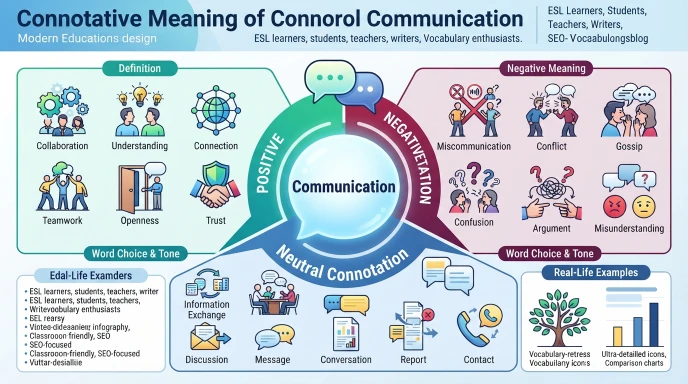
Connotative Meaning
(Connotation: the emotional or cultural feeling associated with a word beyond its dictionary meaning.)
- Positive tone: Understanding, cooperation, connection, teamwork.
- Negative tone: Miscommunication, conflict, misunderstanding when communication fails.
- Neutral tone: The simple exchange of information or messages.
Etymology
- Originates from the Latin word communicare.
- Meaning: to share, make common, or impart information.
- Entered English through Old French communication.
Short History of Communication
Old English (450–1100)
- The modern word communication was not commonly used.
- People used native words related to speaking, telling, and sharing.
Middle English (1100–1500)
- Influenced by French and Latin vocabulary.
- Communication began appearing with meanings related to sharing information.
Modern English (1500–Present)
- Became widely used in education, government, science, and business.
- Expanded to include digital communication such as emails, texts, and social media.
Pronunciation (US & UK – IPA)
US: /kəˌmjuːnəˈkeɪʃən/
UK: /kəˌmjuːnɪˈkeɪʃən/
Syllables
com-mu-ni-ca-tion
Affixation Pattern of Communication
Root: communicate
Prefix: com- (together)
Suffix: -ion (forms a noun)
Word Formation
- Communicate (Verb) – to share information.
- Communication (Noun) – the act of sharing information.
- Communicator (Noun) – a person who communicates.
- Communicative (Adjective) – willing to talk and share ideas.
- Communicatively (Adverb) – in a communicative manner.
- Miscommunication (Noun) – failure in communication.
- Telecommunication (Noun) – communication over distance.
- Communiqué (Noun) – an official statement.
Synonyms of Communication
1. Conversation (Noun)
US: /ˌkɑːnvərˈseɪʃən/ | UK: /ˌkɒnvəˈseɪʃən/
Meaning: An informal exchange of ideas between people.
Examples:
- We had a long conversation about our future.
- Their conversation was friendly and helpful.
2. Discussion (Noun)
US: /dɪˈskʌʃən/ | UK: /dɪˈskʌʃən/
Meaning: A detailed talk about a topic.
Examples:
- The team held a discussion about the project.
- We had a discussion in class today.
3. Dialogue (Noun)
US: /ˈdaɪəlɔːɡ/ | UK: /ˈdaɪəlɒɡ/
Meaning: A conversation between two or more people.
Examples:
- The leaders opened a dialogue.
- Good dialogue solves many problems.
4. Exchange (Noun)
US: /ɪksˈtʃeɪndʒ/ | UK: /ɪksˈtʃeɪndʒ/
Meaning: Giving and receiving information.
Examples:
- The exchange of ideas was productive.
- Students enjoyed the cultural exchange.
5. Interaction (Noun)
US: /ˌɪntərˈækʃən/ | UK: /ˌɪntərˈækʃən/
Meaning: Communication between people or groups.
Examples:
- Social interaction is important.
- The teacher encouraged interaction.
6. Correspondence (Noun)
US: /ˌkɔːrəˈspɑːndəns/ | UK: /ˌkɒrəˈspɒndəns/
Meaning: Communication through letters or messages.
Examples:
- Their correspondence lasted years.
- Business correspondence should be clear.
7. Contact (Noun)
US: /ˈkɑːntækt/ | UK: /ˈkɒntækt/
Meaning: Connection or communication with someone.
Examples:
- Keep contact with your family.
- We stayed in contact after graduation.
8. Connection (Noun)
US: /kəˈnekʃən/ | UK: /kəˈnekʃən/
Meaning: A relationship created through communication.
Examples:
- The speech created a strong connection.
- Communication builds connection.
9. Message (Noun)
US: /ˈmesɪdʒ/ | UK: /ˈmesɪdʒ/
Meaning: Information sent to someone.
Examples:
- I received your message.
- Her message was inspiring.
10. Statement (Noun)
US: /ˈsteɪtmənt/ | UK: /ˈsteɪtmənt/
Meaning: A spoken or written declaration.
Examples:
- The company released a statement.
- His statement clarified the issue.
11. Announcement (Noun)
US: /əˈnaʊnsmənt/ | UK: /əˈnaʊnsmənt/
Meaning: A public communication of information.
Examples:
- The announcement surprised everyone.
- We heard the announcement this morning.
12. Report (Noun)
US: /rɪˈpɔːrt/ | UK: /rɪˈpɔːt/
Meaning: Information given formally.
Examples:
- She submitted a report.
- The report explained the results.
13. Briefing (Noun)
US: /ˈbriːfɪŋ/ | UK: /ˈbriːfɪŋ/
Meaning: A short informative meeting.
Examples:
- We attended a briefing.
- The manager gave a briefing.
14. Notification (Noun)
US: /ˌnoʊtɪfɪˈkeɪʃən/ | UK: /ˌnəʊtɪfɪˈkeɪʃən/
Meaning: Official information given to someone.
Examples:
- I received a notification.
- The notification arrived today.
15. Transmission (Noun)
US: /trænzˈmɪʃən/ | UK: /trænzˈmɪʃən/
Meaning: Sending information from one place to another.
Examples:
- Data transmission was fast.
- The transmission reached its destination.
16. Disclosure (Noun)
US: /dɪsˈkloʊʒər/ | UK: /dɪsˈkləʊʒə/
Meaning: Revealing information.
Examples:
- The disclosure shocked investors.
- Full disclosure is important.
17. Consultation (Noun)
US: /ˌkɑːnsəlˈteɪʃən/ | UK: /ˌkɒnsəlˈteɪʃən/
Meaning: Communication for advice or guidance.
Examples:
- The doctor offered a consultation.
- We arranged a consultation meeting.
18. Negotiation (Noun)
US: /nɪˌɡoʊʃiˈeɪʃən/ | UK: /nɪˌɡəʊʃiˈeɪʃən/
Meaning: Discussion to reach an agreement.
Examples:
- The negotiation lasted hours.
- Successful negotiation requires patience.
19. Conference (Noun)
US: /ˈkɑːnfərəns/ | UK: /ˈkɒnfərəns/
Meaning: A formal meeting for discussion.
Examples:
- They attended a conference.
- The conference focused on education.
20. Meeting (Noun)
US: /ˈmiːtɪŋ/ | UK: /ˈmiːtɪŋ/
Meaning: A gathering for communication.
Examples:
- The meeting starts at nine.
- We had a productive meeting.
21. Interview (Noun)
US: /ˈɪntərvjuː/ | UK: /ˈɪntəvjuː/
Meaning: A formal question-and-answer conversation.
Examples:
- She attended an interview.
- The interview went well.
22. Address (Noun)
US: /əˈdres/ | UK: /əˈdres/
Meaning: A formal speech.
Examples:
- The president delivered an address.
- Her address inspired listeners.
23. Speech (Noun)
US: /spiːtʃ/ | UK: /spiːtʃ/
Meaning: Spoken communication to an audience.
Examples:
- His speech was memorable.
- The speech lasted ten minutes.
24. Presentation (Noun)
US: /ˌprezənˈteɪʃən/ | UK: /ˌprezənˈteɪʃən/
Meaning: Information given to an audience.
Examples:
- She prepared a presentation.
- The presentation was informative.
25. Expression (Noun)
US: /ɪkˈspreʃən/ | UK: /ɪkˈspreʃən/
Meaning: The act of communicating thoughts or feelings.
Examples:
- Art is a form of expression.
- Free expression is important.
26. Articulation (Noun)
US: /ɑːrˌtɪkjəˈleɪʃən/ | UK: /ɑːˌtɪkjəˈleɪʃən/
Meaning: Clear expression of ideas.
Examples:
- Her articulation impressed everyone.
- Good articulation improves speaking.
27. Conveyance (Noun)
US: /kənˈveɪəns/ | UK: /kənˈveɪəns/
Meaning: The act of communicating information.
Examples:
- The conveyance of facts was clear.
- Effective conveyance helps learning.
28. Outreach (Noun)
US: /ˈaʊtriːtʃ/ | UK: /ˈaʊtriːtʃ/
Meaning: Communication aimed at helping others.
Examples:
- The organization expanded outreach.
- Outreach improved community awareness.
29. Liaison (Noun)
US: /liˈeɪzɑːn/ | UK: /liˈeɪzɒn/
Meaning: Communication between groups.
Examples:
- She acts as a liaison.
- Effective liaison prevents confusion.
30. Networking (Noun)
US: /ˈnetwɜːrkɪŋ/ | UK: /ˈnetwɜːkɪŋ/
Meaning: Building relationships through communication.
Examples:
- Networking creates opportunities.
- Professional networking is valuable.
Formal and Casual Alternatives
Formal Synonyms
- Correspondence
- Consultation
- Negotiation
- Briefing
- Conference
- Presentation
- Liaison
- Disclosure
Casual Synonyms
- Conversation
- Talk
- Chat
- Contact
- Exchange
- Message
- Interaction
- Connection
Prototype Meaning
The most typical meaning of communication is the sharing of information between people. When people hear the word communication, they usually imagine talking, listening, messaging, emailing, or exchanging ideas.
It is the basic process that allows people to understand one another and build relationships.
Prototype Categorization
Communication synonyms can be grouped into categories:
- Everyday Talking: Conversation, Dialogue, Discussion, Exchange.
- Business Communication: Briefing, Consultation, Negotiation, Meeting.
- Written Communication: Correspondence, Message, Notification, Report.
- Public Communication: Speech, Address, Presentation, Announcement.
- Relationship Building: Contact, Connection, Networking, Liaison.
- Information Sharing: Transmission, Disclosure, Conveyance, Expression.
Categorization helps writers choose the most accurate synonym for a specific context and audience.
Antonyms of Communication
- Silence (Noun): Absence of speech or communication.
- Secrecy (Noun): Keeping information hidden.
- Concealment (Noun): The act of hiding information.
- Suppression (Noun): Preventing information from being shared.
- Isolation (Noun): Lack of contact with others.
- Withholding (Verb/Noun): Refusing to share information.
Related Words
- Communicate (Verb)
- Communicator (Noun)
- Communicative (Adjective)
- Communiqué (Noun)
- Telecommunication (Noun)
- Miscommunication (Noun)
- Interaction (Noun)
- Expression (Noun)
Short Questions and Answers
- What does communication mean?
Communication means sharing information, ideas, thoughts, or feelings with others. - When should communication be used?
It is used when talking about exchanging information in personal, educational, social, or professional situations. - Is communication positive or negative?
It is generally neutral, but it can have positive or negative effects depending on the context. - How is it different from similar words?
Communication is a broad term, while words like conversation, discussion, and correspondence refer to specific types of communication.
Conclusion
Communication is one of the most important skills in English and everyday life. Understanding the meaning of communication and its many synonyms helps learners express ideas more clearly and accurately
. Using different words such as conversation, dialogue, correspondence, and interaction makes writing and speaking more engaging while avoiding repetition. Learning pronunciation, history, connotation, and related vocabulary also strengthens language knowledge.
if you are a student, teacher, writer, or professional, expanding your vocabulary with communication synonyms can improve confidence and fluency. Make vocabulary learning a daily habit, and you will become a stronger communicator in both written and spoken English.
Explore more about!
- Synonyms for Vulnerable: Alternative Words & Meaning
- Synonyms for Horny 30 Powerful Words to Vocabulary

I am an American author, and I write books about power, strategy, and human behavior. My writing style is simple but deep, and I try to explain how people think and act in real-life situations.
I studied classical studies, and before becoming a writer, I worked in different fields which helped me understand people and life better.
My most famous books include The 48 Laws of Power, The Art of Seduction, and Mastery. These books are widely read by business people, leaders, and students around the world.