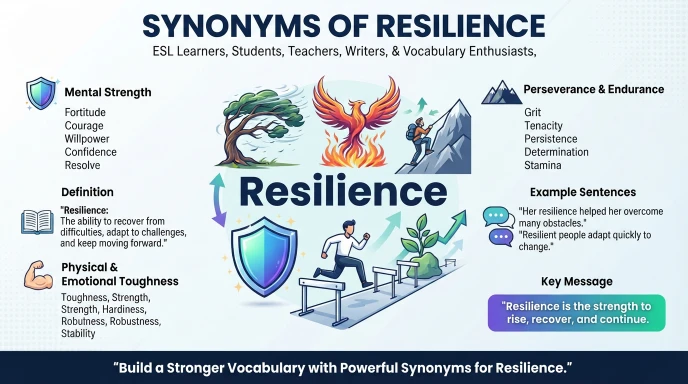
Resilience means the ability to recover from difficulties and keep moving forward after problems or challenges. Imagine a student who fails an exam but studies harder and passes the next one. That ability to bounce back is called resilience.
People often use this word when talking about success, mental strength, personal growth, education, and business.
Learning synonyms of resilience is important for English learners, writers, students, and content creators.
Using different words helps improve vocabulary, makes writing more interesting, and prevents repetition. In this article, you will learn the meaning of resilience, its pronunciation, history, grammar, connotative meaning, and 30 useful synonyms.
You will also see simple examples, semantic categories, antonyms, related words, and frequently asked questions to strengthen your understanding of this powerful English word.
Meaning of Resilience
Definition
Resilience (Noun):
The ability to recover quickly from difficulties, stress, failure, or challenges.
Examples
- Her resilience helped her overcome many problems.
- The team’s resilience impressed everyone after the loss.
Connotative Meaning
(Connotation: the emotional, cultural, or suggested meaning connected to a word beyond its dictionary definition.)
- Positive tone: Strength, courage, determination, recovery, persistence.
- Negative tone: Sometimes suggests hardship, struggle, or difficult experiences.
- Neutral tone: Ability to adapt and continue despite change or pressure.
Etymology
- Comes from the Latin word resilire.
- Resilire means “to jump back” or “to rebound.”
- Entered English through French and Latin influences.
- Originally described physical rebounding before being used for mental and emotional strength.
Short History of the Word
Old English (450–1100)
- The exact word resilience was not used in Old English.
- Similar ideas were expressed through words meaning strength and endurance.
Middle English (1100–1500)
- Latin and French vocabulary influenced English.
- Concepts of recovery and endurance became more common.
Modern English (1500–Present)
- Resilience entered English and expanded in meaning.
- Today it is used in psychology, education, business, engineering, and everyday life.
Pronunciation (US & UK – IPA)
US: /rɪˈzɪliəns/
UK: /rɪˈzɪliəns/
Syllables
re-sil-ience
Affixation Pattern of Resilience
Root: resil-
Prefix: None
Suffix: -ence
Word Formation of Resilience
- Resilience (Noun)
- Resilient (Adjective)
- Resiliently (Adverb)
- Resiliency (Noun)
- Nonresilient (Adjective)
- Resilientness (Noun)
Synonyms of Resilience
1. Strength (Noun)
US: /streŋkθ/ | UK: /streŋθ/
Meaning: The power to withstand pressure or difficulty.
Examples:
- She showed great strength during hard times.
- Inner strength helped him succeed.
2. Toughness (Noun)
US: /ˈtʌfnəs/ | UK: /ˈtʌfnəs/
Meaning: The ability to handle difficult conditions.
Examples:
- His toughness inspired the team.
- Toughness is important in sports.
3. Endurance (Noun)
US: /ɪnˈdʊrəns/ | UK: /ɪnˈdjʊərəns/
Meaning: The ability to continue despite hardship.
Examples:
- Endurance helped her finish the race.
- The job requires endurance.
4. Persistence (Noun)
US: /pərˈsɪstəns/ | UK: /pəˈsɪstəns/
Meaning: Continuing despite obstacles.
Examples:
- Persistence led to success.
- Her persistence impressed everyone.
5. Determination (Noun)
US: /dɪˌtɜːrmɪˈneɪʃən/ | UK: /dɪˌtɜːmɪˈneɪʃən/
Meaning: Strong commitment to achieve a goal.
Examples:
- Determination helped him win.
- She worked with determination.
6. Fortitude (Noun)
US: /ˈfɔːrtɪtuːd/ | UK: /ˈfɔːtɪtjuːd/
Meaning: Courage during pain or hardship.
Examples:
- He faced challenges with fortitude.
- Her fortitude amazed others.
7. Stamina (Noun)
US: /ˈstæmɪnə/ | UK: /ˈstæmɪnə/
Meaning: Physical or mental staying power.
Examples:
- Athletes need stamina.
- The project required stamina.
8. Grit (Noun)
US: /ɡrɪt/ | UK: /ɡrɪt/
Meaning: Courage and determination.
Examples:
- Grit helped her overcome failure.
- Success often requires grit.
9. Hardiness (Noun)
US: /ˈhɑːrdinəs/ | UK: /ˈhɑːdinəs/
Meaning: Ability to survive difficult conditions.
Examples:
- The plant’s hardiness is impressive.
- Hardiness helps people adapt.
10. Durability (Noun)
US: /ˌdʊrəˈbɪləti/ | UK: /ˌdjʊərəˈbɪləti/
Meaning: Ability to last a long time.
Examples:
- Durability is a key feature.
- The material offers durability.
11. Adaptability (Noun)
US: /əˌdæptəˈbɪləti/ | UK: /əˌdæptəˈbɪləti/
Meaning: Ability to adjust to change.
Examples:
- Adaptability is valuable at work.
- Her adaptability helped her succeed.
12. Flexibility (Noun)
US: /ˌflɛksəˈbɪləti/ | UK: /ˌfleksəˈbɪləti/
Meaning: Willingness to adjust when needed.
Examples:
- Flexibility improves teamwork.
- Flexibility helps during change.
13. Resolve (Noun)
US: /rɪˈzɑːlv/ | UK: /rɪˈzɒlv/
Meaning: Firm determination.
Examples:
- She showed strong resolve.
- Resolve helped him continue.
14. Courage (Noun)
US: /ˈkɜːrɪdʒ/ | UK: /ˈkʌrɪdʒ/
Meaning: Bravery in difficult situations.
Examples:
- Courage helped her speak up.
- He acted with courage.
15. Tenacity (Noun)
US: /təˈnæsəti/ | UK: /təˈnæsɪti/
Meaning: Refusing to give up.
Examples:
- Tenacity brought success.
- Her tenacity inspired others.
16. Perseverance (Noun)
US: /ˌpɜːrsəˈvɪrəns/ | UK: /ˌpɜːsɪˈvɪərəns/
Meaning: Continued effort despite difficulty.
Examples:
- Perseverance paid off.
- The goal required perseverance.
17. Stability (Noun)
US: /stəˈbɪləti/ | UK: /stəˈbɪləti/
Meaning: Ability to remain steady.
Examples:
- Stability is important in life.
- The company maintained stability.
18. Resistance (Noun)
US: /rɪˈzɪstəns/ | UK: /rɪˈzɪstəns/
Meaning: Ability to oppose pressure.
Examples:
- Resistance prevented damage.
- The material has high resistance.
19. Recovery (Noun)
US: /rɪˈkʌvəri/ | UK: /rɪˈkʌvəri/
Meaning: Return to normal after difficulty.
Examples:
- Recovery took several weeks.
- Her recovery was remarkable.
20. Rebound (Noun)
US: /ˈriːbaʊnd/ | UK: /ˈriːbaʊnd/
Meaning: A return after failure or loss.
Examples:
- The company made a rebound.
- His rebound was impressive.
21. Self-Reliance (Noun)
US: /ˌself rɪˈlaɪəns/ | UK: /ˌself rɪˈlaɪəns/
Meaning: Dependence on oneself.
Examples:
- Self-reliance builds confidence.
- She values self-reliance.
22. Backbone (Noun)
US: /ˈbækboʊn/ | UK: /ˈbækbəʊn/
Meaning: Strength of character.
Examples:
- He showed backbone.
- Backbone helps during crises.
23. Spirit (Noun)
US: /ˈspɪrɪt/ | UK: /ˈspɪrɪt/
Meaning: Energy and determination.
Examples:
- Her spirit never faded.
- Team spirit boosted morale.
24. Energy (Noun)
US: /ˈenərdʒi/ | UK: /ˈenədʒi/
Meaning: Power to act or continue.
Examples:
- She works with energy.
- Energy drives success.
25. Robustness (Noun)
US: /roʊˈbʌstnəs/ | UK: /rəʊˈbʌstnəs/
Meaning: Strong and healthy condition.
Examples:
- The system’s robustness is valuable.
- Robustness improves performance.
26. Vigour (Noun)
US: /ˈvɪɡər/ | UK: /ˈvɪɡə/
Meaning: Physical or mental strength.
Examples:
- He worked with vigour.
- Vigour improves productivity.
27. Resourcefulness (Noun)
US: /rɪˈsɔːrsfəlnəs/ | UK: /rɪˈsɔːsfəlnəs/
Meaning: Ability to solve problems creatively.
Examples:
- Resourcefulness helped her succeed.
- The team showed resourcefulness.
28. Survival (Noun)
US: /sərˈvaɪvəl/ | UK: /səˈvaɪvəl/
Meaning: Continuing to live or exist.
Examples:
- Survival required courage.
- The story is about survival.
29. Power (Noun)
US: /ˈpaʊər/ | UK: /ˈpaʊə/
Meaning: Ability to act effectively.
Examples:
- Inner power motivates people.
- She found power in adversity.
30. Steadfastness (Noun)
US: /ˈstedfæstnəs/ | UK: /ˈstedfɑːstnəs/
Meaning: Remaining firm and loyal.
Examples:
- His steadfastness earned respect.
- Steadfastness is a leadership quality.
Prototype Meaning
The most common meaning of resilience is the ability to recover from challenges, setbacks, failures, or stress and continue moving forward.
When people hear the word resilience, they usually think of someone who stays strong during difficult times and does not give up.
Prototype Categorization
- Mental Strength: grit, fortitude, courage, resolve, determination
- Persistence: perseverance, tenacity, persistence, steadfastness
- Adaptation: adaptability, flexibility, resourcefulness
- Physical Strength: stamina, endurance, vigour, toughness
- Recovery: rebound, recovery, survival
- Stability: robustness, durability, stability, resistance
Categorization helps writers choose the most accurate synonym. For example, adaptability fits change, while perseverance fits long-term effort.
Antonyms of Resilience
- Fragility (Noun): Easily damaged or broken.
- Weakness (Noun): Lack of strength.
- Vulnerability (Noun): Easily harmed or affected.
- Instability (Noun): Lack of steadiness.
- Helplessness (Noun): Inability to help oneself.
- Surrender (Noun): Giving up resistance.
- Defeatism (Noun): Expectation of failure.
- Timidity (Noun): Lack of courage.
Related Words
- Resilient (Adjective)
- Resiliently (Adverb)
- Resiliency (Noun)
- Recovery (Noun)
- Endurance (Noun)
- Adaptability (Noun)
- Persistence (Noun)
- Determination (Noun)
Short Questions and Answers
- What does resilience mean?
Resilience means the ability to recover from difficulties and continue moving forward. - When should resilience be used?
Use it when talking about overcoming challenges, stress, failure, or change. - Is resilience positive or negative?
It is generally a positive word because it describes strength and recovery. - How is it different from similar words?
Resilience focuses on recovery after hardship, while endurance focuses on lasting through hardship and adaptability focuses on adjusting to change.
Conclusion
Resilience is a powerful word that describes the ability to recover from challenges and keep going. Learning resilience and its synonyms helps expand vocabulary, improve communication, and make writing more engaging.
Different synonyms such as perseverance, grit, adaptability, and fortitude allow writers and speakers to express ideas more precisely. Understanding pronunciation, history, connotation, and related words also strengthens language skills.
By using these words regularly, English learners can avoid repetition, sound more confident, and improve both writing and speaking. Make vocabulary learning a daily habit, and you will gradually build stronger English skills and greater confidence in communication.
Read more about!
- Sigma Synonyms 30 Words to Boost Vocabulary
- Powerful Alternatives to “Eager” You Should Know
- Synonyms for Confidence: 30 Words to Expand Your Vocabulary

I am an American author, and I write books about power, strategy, and human behavior. My writing style is simple but deep, and I try to explain how people think and act in real-life situations.
I studied classical studies, and before becoming a writer, I worked in different fields which helped me understand people and life better.
My most famous books include The 48 Laws of Power, The Art of Seduction, and Mastery. These books are widely read by business people, leaders, and students around the world.