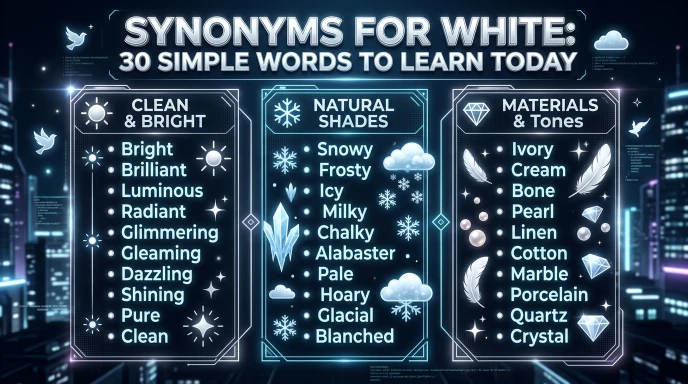
“Learn 30 powerful synonyms for ‘White’ to expand your vocabulary and enhance your English communication skills.”
The word white means a color that is very light and has no strong shade. Imagine a child wearing a white shirt on the first day of school. The clean, bright color makes the shirt look fresh and neat.
The word white is one of the most common words in English because people use it every day to describe colors, objects, clothing, nature, emotions, and ideas.
Learning synonyms for white helps English learners describe things in a more creative and accurate way. It also helps content writers make their descriptions richer and avoid repeating the same word.
This article explains the meaning of white, its synonyms, examples, grammar use, pronunciation, history, and semantic categories. By learning these words, readers can improve their vocabulary and express ideas with greater confidence.
Meaning of White
Definition
White (adjective):
A color that is very light, like snow, milk, or fresh paper.
White (noun):
The color that reflects all visible light and appears bright.
Examples
- She wore a white dress at the wedding ceremony.
- The walls of the room are painted white to make the space look larger.
Connotative Meaning
Connotation (the feelings, ideas, or meanings that people connect with a word beyond its basic definition):
- Positive tone:
White often represents purity, cleanliness, peace, innocence, and simplicity.
Example: A white flower may represent beauty and peace. - Negative tone:
White can sometimes suggest emptiness, coldness, or a lack of emotion depending on the context.
Example: A white, empty room may feel lonely. - Neutral tone:
White can simply describe a color without any emotional meaning.
Example: The car is white.
Etymology
- The word white comes from the Old English word hwīt, meaning “bright,” “shining,” or “clear.”
- It is connected to the Proto-Germanic word hwītaz, which also meant “bright” or “white.”
- The original idea of the word focused on brightness and light rather than only color.
Short History of the Keyword
- Old English (450–1100):
The word appeared as hwīt in Old English texts. It was used to describe brightness, light colors, and shining objects. - Middle English (1100–1500):
The spelling changed from hwīt to forms like whit and later white. The word became more common in everyday descriptions. - Modern English (1500–Present):
White developed many meanings. It is now used for color, symbolism, identity, objects, materials, and ideas such as peace and cleanliness.
Pronunciation (US & UK – IPA)
US: /waɪt/
UK: /waɪt/
Syllables
white
(One syllable)
Affixation Pattern of White
Root:
white / hwīt
Meaning: bright, shining, light-colored.
Prefix:
None
Suffix:
None
Word Formation of White
Words formed from white include:
- White (adjective): describing a light color.
- Whiten (verb): to make something white.
- Whitened (adjective/verb): made white or became white.
- Whitening (noun/verb): the process of making something white.
- Whitish (adjective): slightly white.
- Whiteness (noun): the quality or state of being white.
Grammatical categories:
- Adjective: white, whitish
- Verb: whiten
- Noun: whiteness, whitening
Synonyms of White
1. Snowy (Adjective)
US IPA: /ˈsnoʊ.i/ | UK IPA: /ˈsnəʊ.i/
Meaning: Having the color or appearance of fresh snow.
Examples:
- The mountains looked snowy after the winter storm.
- She wore a snowy dress for the special event.
2. Ivory (Adjective)
US IPA: /ˈaɪ.vər.i/ | UK IPA: /ˈaɪ.vər.i/
Meaning: A soft white color with a slight yellow shade.
Examples:
- The bride chose an ivory wedding gown.
- The room had ivory curtains and elegant furniture.
3. Creamy (Adjective)
US IPA: /ˈkriː.mi/ | UK IPA: /ˈkriː.mi/
Meaning: A soft white or pale yellow color like cream.
Examples:
- The walls were painted a creamy white.
- She selected a creamy fabric for the sofa.
4. Pearl (Adjective)
US IPA: /pɝːl/ | UK IPA: /pɜːl/
Meaning: Having a smooth, shining white appearance like a pearl.
Examples:
- She wore a pearl necklace with her dress.
- The car had a beautiful pearl finish.
5. Milky (Adjective)
US IPA: /ˈmɪl.ki/ | UK IPA: /ˈmɪl.ki/
Meaning: Looking white like milk.
Examples:
- The lake had a milky appearance in the morning fog.
- The glass was filled with a milky drink.
6. Pale (Adjective)
US IPA: /peɪl/ | UK IPA: /peɪl/
Meaning: Having a light color with little strength or brightness.
Examples:
- She painted the walls a pale white color.
- The morning sky had a pale glow.
7. Bright (Adjective)
US IPA: /braɪt/ | UK IPA: /braɪt/
Meaning: Full of light or having a strong clear color.
Examples:
- The bright white snow covered the ground.
- He wore a bright shirt that was easy to see.
8. Clear (Adjective)
US IPA: /klɪr/ | UK IPA: /klɪə/
Meaning: Pure, clean, or free from darkness or color.
Examples:
- The clear white glass looked beautiful on the table.
- The sky became clear after the rain.
9. Pure (Adjective)
US IPA: /pjʊr/ | UK IPA: /pjʊə/
Meaning: Clean, natural, and without anything mixed in.
Examples:
- The snow looked pure and untouched.
- The artist used pure white paint.
10. Clean (Adjective)
US IPA: /kliːn/ | UK IPA: /kliːn/
Meaning: Free from dirt and often connected with a fresh white appearance.
Examples:
- He wore a clean white shirt to the interview.
- The kitchen had a clean and modern design.
11. Blank (Adjective)
US IPA: /blæŋk/ | UK IPA: /blæŋk/
Meaning: Empty, plain, or without marks or colors.
Examples:
- She wrote her ideas on a blank white page.
- The artist started with a blank canvas.
12. Colorless (Adjective)
US IPA: /ˈkʌl.ɚ.ləs/ | UK IPA: /ˈkʌl.ə.ləs/
Meaning: Having no visible color.
Examples:
- The clear liquid looked colorless.
- The design used simple colorless materials.
13. Silvery (Adjective)
US IPA: /ˈsɪl.vɚ.i/ | UK IPA: /ˈsɪl.vər.i/
Meaning: Having a shiny light gray or white appearance.
Examples:
- The moon created a silvery light over the water.
- She decorated the room with silvery ornaments.
14. Frosty (Adjective)
US IPA: /ˈfrɔː.sti/ | UK IPA: /ˈfrɒs.ti/
Meaning: Looking white because of frost or ice.
Examples:
- The trees had a frosty appearance in winter.
- The frosty morning made the garden look magical.
15. Chalky (Adjective)
US IPA: /ˈtʃɔː.ki/ | UK IPA: /ˈtʃɔː.ki/
Meaning: Having a dull white color like chalk.
Examples:
- The wall had a chalky white surface.
- The soil looked dry and chalky.
16. Frosted (Adjective)
US IPA: /ˈfrɔː.stɪd/ | UK IPA: /ˈfrɒs.tɪd/
Meaning: Covered with or looking like frost, creating a soft white appearance.
Examples:
- The window had a frosted white design.
- The cake was decorated with frosted icing.
17. Opal (Adjective)
US IPA: /ˈoʊ.pəl/ | UK IPA: /ˈəʊ.pəl/
Meaning: Having a soft white color with a gentle shine.
Examples:
- She wore an opal-colored necklace.
- The sky had an opal glow at sunrise.
18. Linen (Adjective)
US IPA: /ˈlɪn.ɪn/ | UK IPA: /ˈlɪn.ɪn/
Meaning: Having the natural soft white color of linen fabric.
Examples:
- The room had linen-colored curtains.
- He chose a linen white shirt for summer.
19. Alabaster (Adjective)
US IPA: /ˈæl.ə.bæs.tɚ/ | UK IPA: /ˈæl.ə.bɑː.stə/
Meaning: Having a smooth, pale white appearance like alabaster stone.
Examples:
- The statue had an alabaster surface.
- The artist created a figure with alabaster skin tones.
20. Bleached (Adjective)
US IPA: /bliːtʃt/ | UK IPA: /bliːtʃt/
Meaning: Made very white by removing color.
Examples:
- The towels were bleached white and clean.
- She bought bleached cotton fabric for the project.
21. Snow-white (Adjective)
US IPA: /ˈsnoʊˌwaɪt/ | UK IPA: /ˈsnəʊˌwaɪt/
Meaning: Extremely white like fresh snow.
Examples:
- The snow-white dress looked beautiful.
- The bird had snow-white feathers.
22. Milky-white (Adjective)
US IPA: /ˈmɪl.ki ˌwaɪt/ | UK IPA: /ˈmɪl.ki ˌwaɪt/
Meaning: A soft white color similar to milk.
Examples:
- The glass had a milky-white appearance.
- The stone showed a milky-white shade.
23. Pearly (Adjective)
US IPA: /ˈpɝː.li/ | UK IPA: /ˈpɜː.li/
Meaning: White and shiny like a pearl.
Examples:
- The necklace had a pearly shine.
- The surface looked pearly under the light.
24. Ghostly (Adjective)
US IPA: /ˈɡoʊst.li/ | UK IPA: /ˈɡəʊst.li/
Meaning: Pale white and sometimes connected with a mysterious feeling.
Examples:
- A ghostly white figure appeared in the fog.
- The moon gave the room a ghostly glow.
25. Silver-white (Adjective)
US IPA: /ˈsɪl.vɚ waɪt/ | UK IPA: /ˈsɪl.və waɪt/
Meaning: A white color with a silver-like shine.
Examples:
- The fish had silver-white scales.
- The car had a silver-white paint finish.
26. Brilliant (Adjective)
US IPA: /ˈbrɪl.jənt/ | UK IPA: /ˈbrɪl.jənt/
Meaning: Extremely bright and full of light.
Examples:
- The brilliant white snow reflected sunlight.
- The room looked brilliant with white decorations.
27. Gleaming (Adjective)
US IPA: /ˈɡliː.mɪŋ/ | UK IPA: /ˈɡliː.mɪŋ/
Meaning: Shining brightly and appearing clean.
Examples:
- The kitchen had gleaming white surfaces.
- The car looked gleaming after washing.
28. Luminous (Adjective)
US IPA: /ˈluː.mə.nəs/ | UK IPA: /ˈluː.mɪ.nəs/
Meaning: Giving off or reflecting a soft bright light.
Examples:
- The moon had a luminous white glow.
- The painting showed a luminous white background.
29. Radiant (Adjective)
US IPA: /ˈreɪ.di.ənt/ | UK IPA: /ˈreɪ.di.ənt/
Meaning: Shining brightly or showing beauty and happiness.
Examples:
- She looked radiant in a white dress.
- The radiant white flowers filled the garden.
30. Brilliant White (Adjective)
US IPA: /ˈbrɪl.jənt waɪt/ | UK IPA: /ˈbrɪl.jənt waɪt/
Meaning: A very bright and pure white color.
Examples:
- The walls were painted brilliant white.
- The brilliant white snow covered the field.
Prototype Meaning of White
The most typical meaning of white is a bright color that looks like snow, milk, or clean paper. When people hear the word white, they usually imagine something clean, light, pure, and simple.
It is often connected with freshness, peace, and brightness. White is also commonly used to describe everyday objects such as clothes, walls, flowers, animals, and natural elements.
Prototype Categorization
Synonyms of white can be grouped into different categories. This helps writers choose the right word for describing colors, emotions, objects, and styles.
- Pure and clean white shades:
Pure, clean, snowy, snow-white, bleached
These words are useful for describing freshness, hygiene, and simplicity. - Soft and elegant white shades:
Ivory, creamy, pearl, pearly, opal, alabaster
These words are often used in fashion, design, and beauty descriptions. - Bright and shining white shades:
Bright, brilliant, gleaming, luminous, radiant
These words describe strong light and attractive appearances. - Natural white appearances:
Milky, frosty, chalky, linen, silvery
These words describe colors found in nature and materials. - Mystical or emotional white shades:
Ghostly, clear, blank, colorless
These words can create special moods in stories and creative writing.
Categorizing synonyms helps writers select words that match the exact image, feeling, and purpose of their writing.
Antonyms of White
- Black (Adjective/Noun): A very dark color that absorbs most light.
- Dark (Adjective): Having little or no light.
- Colored (Adjective): Having a color other than white.
- Gray (Adjective/Noun): A color between black and white.
- Dirty (Adjective): Not clean or covered with unwanted marks.
- Dull (Adjective): Lacking brightness or shine.
- Stained (Adjective): Marked or changed by dirt or color.
Short Questions and Answers
- What does white mean?
Answer: White means a very light color that looks like snow, milk, or fresh paper. - When should white be used?
Answer: Use white when describing a bright color, clean appearance, simple design, or symbolic idea such as peace. - Is white positive or negative?
Answer: White is usually positive because it represents purity, cleanliness, and peace. However, the meaning can change depending on context. - How is white different from similar words?
Answer: White is the basic color word. Words like ivory describe a softer shade, snowy describes a natural white appearance, and luminous describes a bright glowing white.
Conclusion
Learning the word white and its synonyms helps English learners describe colors and ideas with greater accuracy.
Instead of repeating the same word, learners can use words like snowy, ivory, radiant, or luminous to create clearer and more interesting descriptions.
Understanding pronunciation, meanings, tone, and history helps students use vocabulary correctly in different situations.
These synonyms are also useful for writers, designers, and content creators who want to make their descriptions more attractive. Regular vocabulary practice improves speaking, writing, and reading skills. By learning new words every day, English learners can build confidence and communicate more effectively.
Read more about!
- Synonyms for Innovative: 30+ Best Words to Use in English
- Synonyms for Exciting 30 Powerful Words to Improve
- Synonyms for Ability: 30 Powerful Words to Know

I am a linguist with 17 years of experience in English language teaching, including postgraduate-level instruction. My expertise includes English grammar, and I contribute as a content and blog writer, producing scholarly and educational language resources.