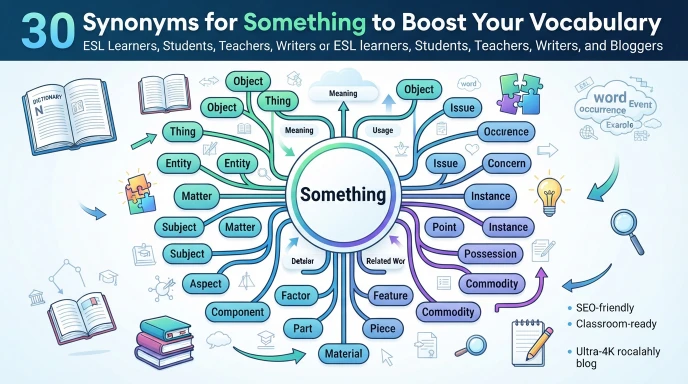
Something is one of the most common words in English. It means an unspecified thing, object, idea, event, or matter. Imagine a friend saying, “I have something important to tell you.” The listener knows a thing exists, but does not yet know what it is.
This simple word appears in daily conversations, books, emails, articles, and speeches.
Learning synonyms for something helps English learners, students, teachers, and content writers express ideas more precisely. Instead of repeating the same word, writers can choose alternatives that better fit the context.
A strong vocabulary improves communication and makes writing more engaging. In this article, you will learn the meaning of something, its pronunciation, grammar, history, connotation, and 30 useful synonyms. You will also explore examples, semantic categories, antonyms, related words, and practical usage tips.
Meaning of Something
Definition
Something (Pronoun):
A thing, object, idea, event, or matter that is not specifically named.
Examples
- I need something to drink.
- She has something exciting to share.
Connotative Meaning
(Connotation: the emotional or cultural feeling connected to a word beyond its dictionary meaning.)
- Positive tone: Can suggest opportunity, value, or importance.
- Negative tone: Can imply uncertainty or a problem.
- Neutral tone: Refers to an unspecified thing.
Etymology
- Origin: Old English
- Derived from sum thing
- Original meaning: “a certain thing” or “one thing”
Short History of the Keyword
Old English (450–1100)
- Used as sum þing meaning “a certain thing.”
Middle English (1100–1500)
- The words gradually combined into forms similar to modern something.
Modern English (1500–Present)
- Became the standard pronoun for an unspecified object, matter, or idea.
Pronunciation (US & UK – IPA)
US: /ˈsʌm.θɪŋ/
UK: /ˈsʌm.θɪŋ/
Syllables
some-thing
Affixation Pattern of Something
Root: thing
Prefix: some-
Suffix: None
Word Formation of the Keyword
- Something (Pronoun)
- Someone (Pronoun)
- Somebody (Pronoun)
- Somewhere (Adverb/Pronoun)
- Someday (Adverb)
- Somewhat (Adverb)
Synonyms of Something
1. Thing (Noun)
US: /θɪŋ/ | UK: /θɪŋ/
Meaning: An object, idea, or matter.
Examples:
- I found a strange thing.
- That thing looks useful.
2. Object (Noun)
US: /ˈɑːb.dʒekt/ | UK: /ˈɒb.dʒekt/
Meaning: A physical item.
Examples:
- The object was on the table.
- She picked up the object.
3. Item (Noun)
US: /ˈaɪ.təm/ | UK: /ˈaɪ.təm/
Meaning: A single thing in a group.
Examples:
- This item is expensive.
- He bought an item online.
4. Matter (Noun)
US: /ˈmæt̬.ɚ/ | UK: /ˈmæt.ə/
Meaning: A subject or issue.
Examples:
- We must discuss the matter.
- It is a serious matter.
5. Subject (Noun)
US: /ˈsʌb.dʒɪkt/ | UK: /ˈsʌb.dʒɪkt/
Meaning: A topic or issue.
Examples:
- The subject changed quickly.
- She introduced a new subject.
6. Topic (Noun)
US: /ˈtɑː.pɪk/ | UK: /ˈtɒp.ɪk/
Meaning: Something being discussed.
Examples:
- The topic was interesting.
- We discussed a new topic.
7. Issue (Noun)
US: /ˈɪʃ.uː/ | UK: /ˈɪʃ.uː/
Meaning: A matter that needs attention.
Examples:
- There is an issue at work.
- The issue was resolved.
8. Concern (Noun)
US: /kənˈsɝːn/ | UK: /kənˈsɜːn/
Meaning: A matter of importance.
Examples:
- Safety is a concern.
- He shared his concern.
9. Entity (Noun)
US: /ˈen.t̬ə.t̬i/ | UK: /ˈen.tɪ.ti/
Meaning: A thing with separate existence.
Examples:
- The company is a legal entity.
- Scientists studied the entity.
10. Element (Noun)
US: /ˈel.ə.mənt/ | UK: /ˈel.ɪ.mənt/
Meaning: A part of a whole.
Examples:
- Trust is an important element.
- The design has a new element.
11. Component (Noun)
US: /kəmˈpoʊ.nənt/ | UK: /kəmˈpəʊ.nənt/
Meaning: A part of something larger.
Examples:
- The machine has one faulty component.
- Each component matters.
12. Aspect (Noun)
US: /ˈæs.pekt/ | UK: /ˈæs.pekt/
Meaning: A particular part or feature.
Examples:
- We studied one aspect.
- This aspect is important.
13. Feature (Noun)
US: /ˈfiː.tʃɚ/ | UK: /ˈfiː.tʃə/
Meaning: A characteristic part.
Examples:
- The phone has a useful feature.
- That feature attracts users.
14. Point (Noun)
US: /pɔɪnt/ | UK: /pɔɪnt/
Meaning: An idea or detail.
Examples:
- She made an important point.
- I understand your point.
15. Detail (Noun)
US: /ˈdiː.teɪl/ | UK: /ˈdiː.teɪl/
Meaning: A small piece of information.
Examples:
- Every detail matters.
- He explained the detail.
16. Fact (Noun)
US: /fækt/ | UK: /fækt/
Meaning: A true piece of information.
Examples:
- That fact surprised me.
- The fact is important.
17. Event (Noun)
US: /ɪˈvent/ | UK: /ɪˈvent/
Meaning: Something that happens.
Examples:
- The event was successful.
- An unexpected event occurred.
18. Occurrence (Noun)
US: /əˈkɝː.əns/ | UK: /əˈkʌr.əns/
Meaning: An event or happening.
Examples:
- The occurrence was unusual.
- We recorded the occurrence.
19. Incident (Noun)
US: /ˈɪn.sə.dənt/ | UK: /ˈɪn.sɪ.dənt/
Meaning: A particular event.
Examples:
- The incident caused concern.
- Police investigated the incident.
20. Situation (Noun)
US: /ˌsɪtʃ.uˈeɪ.ʃən/ | UK: /ˌsɪtʃ.uˈeɪ.ʃən/
Meaning: A set of circumstances.
Examples:
- The situation improved.
- It was a difficult situation.
21. Circumstance (Noun)
US: /ˈsɝː.kəm.stæns/ | UK: /ˈsɜː.kəm.stəns/
Meaning: A condition or fact connected to an event.
Examples:
- Under the circumstance, we waited.
- The circumstance changed.
22. Affair (Noun)
US: /əˈfer/ | UK: /əˈfeə/
Meaning: A matter or event.
Examples:
- It was a private affair.
- The affair attracted attention.
23. Business (Noun)
US: /ˈbɪz.nəs/ | UK: /ˈbɪz.nɪs/
Meaning: A matter requiring action.
Examples:
- We have business to discuss.
- That is my business.
24. Case (Noun)
US: /keɪs/ | UK: /keɪs/
Meaning: A particular situation.
Examples:
- This case is unusual.
- The case needs review.
25. Concept (Noun)
US: /ˈkɑːn.sept/ | UK: /ˈkɒn.sept/
Meaning: An abstract idea.
Examples:
- The concept is simple.
- Students learned the concept.
26. Idea (Noun)
US: /aɪˈdiː.ə/ | UK: /aɪˈdɪə/
Meaning: A thought or suggestion.
Examples:
- She shared an idea.
- That idea sounds good.
27. Notion (Noun)
US: /ˈnoʊ.ʃən/ | UK: /ˈnəʊ.ʃən/
Meaning: A belief or idea.
Examples:
- He had a strange notion.
- The notion became popular.
28. Thought (Noun)
US: /θɔːt/ | UK: /θɔːt/
Meaning: An idea formed in the mind.
Examples:
- A thought crossed my mind.
- That thought inspired me.
29. Item of Interest (Noun Phrase)
US: /ˈaɪ.təm əv ˈɪn.trəst/ | UK: /ˈaɪ.təm əv ˈɪn.trəst/
Meaning: Something important or notable.
Examples:
- The report included an item of interest.
- We discussed an item of interest.
30. Particular (Noun)
US: /pɚˈtɪk.jə.lɚ/ | UK: /pəˈtɪk.jʊ.lə/
Meaning: A specific detail or matter.
Examples:
- Explain that particular.
- We discussed every particular.
Formal and Casual Sections
Formal Synonyms
- Entity
- Component
- Aspect
- Concept
- Circumstance
- Particular
- Matter
- Occurrence
Casual Synonyms
- Thing
- Item
- Idea
- Point
- Topic
- Detail
- Event
- Situation
Related Words
- Anything (Pronoun)
- Everything (Pronoun)
- Nothing (Pronoun)
- Someone (Pronoun)
- Somebody (Pronoun)
- Somewhere (Pronoun/Adverb)
- Thing (Noun)
- Object (Noun)
- Idea (Noun)
- Matter (Noun)
Prototype Meaning
The most common meaning of something is an unspecified thing, object, matter, or idea.
When people hear the word, they usually imagine a thing that exists but has not been clearly identified or named.
Prototype Categorization
Categorizing synonyms helps writers select the most accurate word for a situation.
- Physical Things: object, item, entity, component
- Ideas and Thoughts: idea, concept, notion, thought
- Topics and Issues: matter, subject, topic, issue
- Events and Situations: event, occurrence, incident, situation
- Details and Parts: aspect, feature, point, detail
Using categories helps writers choose precise vocabulary instead of relying on the general word something.
Antonyms
- Nothing (Pronoun): No thing; not anything.
- None (Pronoun): Not one of any group.
- Nobody (Pronoun): No person.
- Nowhere (Adverb/Pronoun): No place.
- Void (Noun): An empty state.
- Emptiness (Noun): Lack of content.
- Absence (Noun): The state of not being present.
- Nonexistence (Noun): The condition of not existing.
Short Questions and Answers
- What does something mean?
Something means an unspecified thing, idea, object, or matter. - When should something be used?
Use it when the exact thing is unknown, unnamed, or unimportant. - Is something positive or negative?
It is usually neutral, but context can make it positive or negative. - How is it different from similar words?
Something is very general, while words like object, idea, or event are more specific.
Conclusion
Learning the word something and its synonyms can greatly improve your English vocabulary. While something is useful in everyday communication, using more precise alternatives helps make writing and speaking clearer and more engaging.
Synonyms allow you to avoid repetition, communicate ideas accurately, and sound more confident. Understanding the meaning, pronunciation, connotation, history, and related words of something also helps you use the word correctly in different situations.
By practicing these synonyms regularly, you can strengthen your vocabulary and become a more effective communicator. Small improvements in word choice can make a big difference in both academic and everyday English.
Read more about!
- Synonyms for Disappointed: Powerful Words to Use Instead
- Synonyms for Elite: Powerful Words to Use Instead
- Synonyms for Reason: Powerful Words to Use Instead